
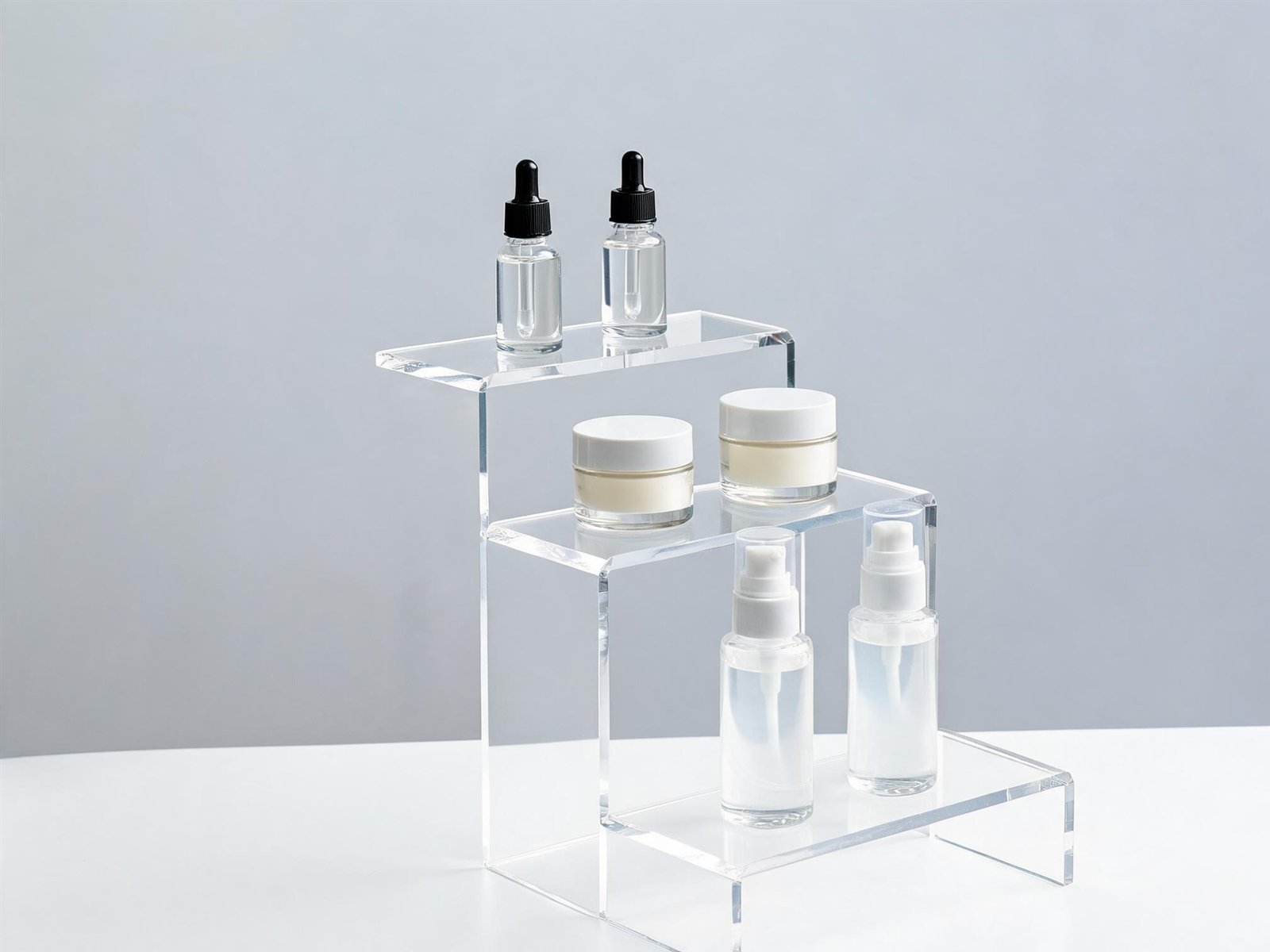
Specifiers often ask us whether acrylic or PETG is the better sheet for a retail display. The honest answer is that both work — but they fail in different ways. Here is how we choose between them in production.
Acrylic: the clarity benchmark
Cast acrylic is the material most people picture when they think of a premium display: glass-like transparency, a stiff panel that stays flat, and edges that polish to a bright finish. It takes UV printing beautifully, holds fine detail when cut or engraved, and can be heat bent into clean angles.
The trade-off is brittleness. Acrylic chips or cracks under a sharp impact, especially at drilled holes and narrow necks. Once cracked, the part usually has to be replaced rather than repaired.
PETG: the impact-resistant option
PETG is tougher. It flexes before it breaks, which makes it a sensible choice for parts that are handled daily, shipped repeatedly, or installed by store staff who may not be gentle. It is also a good fit for outdoor or cold-chain environments where impact risk is higher.
What you give up is optical purity. PETG is slightly softer and less crystal-clear than cast acrylic, and its edges do not polish to the same glassy look. Some print processes also need different adhesion settings.
Where each material wins
- Choose acrylic: cosmetic and jewellery displays, printed standees, premium sign holders, pieces where clarity and edge finish sell the product.
- Choose PETG: high-traffic shelf dividers, children’s display pieces, parts that flex during assembly, and projects where replacement cost matters more than perfect clarity.
- Mix both: a clear acrylic front panel with PETG internal brackets is a common way to protect the visible surface while adding toughness where it is hidden.
Printing and finishing differences
UV printing adheres well to both materials, but the white ink base behaves differently. On clear acrylic, a white layer gives crisp, opaque colour with strong contrast. On PETG, the same artwork can look slightly warmer because the sheet itself is less neutral. If colour accuracy is critical, approve a printed sample on the actual material rather than on a paper proof.
Heat bending is another split. Acrylic bends predictably with strip heaters and hot-wire machines. PETG needs lower temperatures and more controlled cooling, and spring-back can be slightly different. This matters for parts that must fit together, such as a slot-in base or a folded sign holder.
Cost and availability
Extruded acrylic is often the lowest-cost clear sheet, while cast acrylic costs more but machines and polishes better. PETG usually sits between the two. The cheapest sheet is rarely the cheapest display once cutting, printing, polishing and breakage are included — a material that chips during packing can wipe out the saving.
Our default recommendation
For printed display pieces that are seen up close — standees, countertop stands, jewellery risers — we start with cast acrylic. For parts that are handled, shipped loose, or likely to take knocks, we recommend PETG or a mixed construction. Send us the product, the environment and the handling route, and we will specify the material that fits all three.